For men
The Truth About Androgenetic Alopecia: Facts, Not Myths
Learn the facts about the causes and mechanisms of androgenetic alopecia. Separate evidence-based knowledge from common misconceptions.

Androgenetic alopecia accounts for about 95% of all people who experience hair loss. In fact, this condition is so common that up to 70% of men and 40% of women are affected at some point in their lives.
When we talk about androgenetic alopecia in women, clear differences emerge: while roughly one in two men faces this form of hair loss by age 60, only about one in five women does. Hormonal hair loss is often misunderstood and confused with other forms. After menopause, prevalence in women rises sharply. Although androgenetic hair loss can begin in the teenage years, it usually appears between ages 30 and 40.
In this article, we clarify the key facts about androgenetic alopecia. We explain the causes, highlight differences between men and women, and present effective treatment options — such as finasteride, which can stop hair loss in over 90% of men.
What is androgenetic alopecia?

Definition and medical background
Androgenetic alopecia is an androgen-induced, genetically determined form of hair loss [2]. Histologically, progressive miniaturization of terminal hair follicles can be observed in genetically predisposed scalp areas. In addition, the growth phases (anagen phases) of the hair shorten and hair shaft diameter decreases [1].
This leads to characteristic patterns: in men, temples typically recede and thinning develops on the crown (classified by Norwood-Hamilton), while women more often develop mid-part thinning (Ludwig classification) [1]. In men the process often begins in puberty, and by middle age about 50% of men are affected [3].
Difference from hormonal hair loss
There is an important distinction: androgenetic alopecia is not a hormonal disease in the true sense [4]. The cause is not an excess of hormones, but hair roots that overreact to normally circulating hormones [4].
By contrast, hormonal hair loss arises from an imbalance in the hormonal system — for example after stopping the pill, during menopause, or with hormonal conditions such as PCOS [4]. That hair loss often runs diffusely and in episodes, while androgenetic alopecia follows a characteristic pattern [4].
Why the term 'androgenic hair loss' is often misused
The term "androgenetic alopecia" literally means "hair loss due to male hormones" [5]. This leads to a widespread misunderstanding: many people assume elevated hormone levels. In fact, healthy men with androgen-related hair loss generally show no clinically significant changes in their androgen levels [3].
Confusion arises because both terms — androgenetic and hormonal hair loss — are often used synonymously, even though they describe different mechanisms. In androgenetic alopecia, the issue is genetically determined hypersensitivity of the hair follicles to dihydrotestosterone (DHT) [5]. There is no link between baldness and androgen levels in the blood [1].
It is not the hormone level itself that is the problem, but the genetically fixed, individually varying sensitivity of the hair follicles at the predilection sites [1]. Correct distinction is decisive for choosing the right treatment strategy and for treatment success.
Causes and risk factors
In androgenetic alopecia, the interplay between hormones and genetic predisposition is decisive. Several factors determine who is affected and how severe the hair loss becomes.
Role of DHT and testosterone
Dihydrotestosterone (DHT) is the main driver of androgenetic alopecia. This hormone is formed by converting testosterone with the enzyme 5-alpha-reductase [6]. In people with androgenetic alopecia, larger amounts of this enzyme are produced in the hair roots, leading to increased DHT formation [2].
Contrary to popular belief, the problem is not an excess of hormones. Affected people usually have normal androgen levels in the blood [6]. Rather, the hair roots overreact to the DHT that is present [5].
DHT shrinks the hair follicles and shortens the hair growth phase [2]. It also causes blood vessels in the scalp to regress, limiting nutrient supply to the hair roots [5]. The result: thinner, softer hair and eventually hair loss.
Genetic predisposition and inheritance
Hypersensitivity of the hair follicles to DHT is genetically determined [5]. Researchers have identified several genes involved in androgenetic alopecia, including the androgen receptor gene on the X chromosome [5][6].
Inheritance is polygenetic, meaning several genes are involved [6]. Although hereditary hair loss can be passed on from both the maternal and paternal sides [7], inheritance via the X chromosome points to a stronger maternal influence [6].
A family history increases personal risk for androgenetic alopecia [8]. However, the condition can also appear in people whose parents keep a full head of hair into old age [7].
Influence of age and sex
Risk of androgenetic alopecia rises with age. In men, hair loss often begins between ages 30 and 40 [2][4], but can start in the teenage years [6]. Over age 70, about 80% of men are affected [2][6].
In women, androgenetic alopecia typically appears between ages 20 and 40 [2]. Over a lifetime, about 30% to 40% of women are affected [2]. After menopause, prevalence rises because the decline in female sex hormones — which normally counterbalance testosterone — strengthens DHT's influence [1].
Symptoms and course in men and women
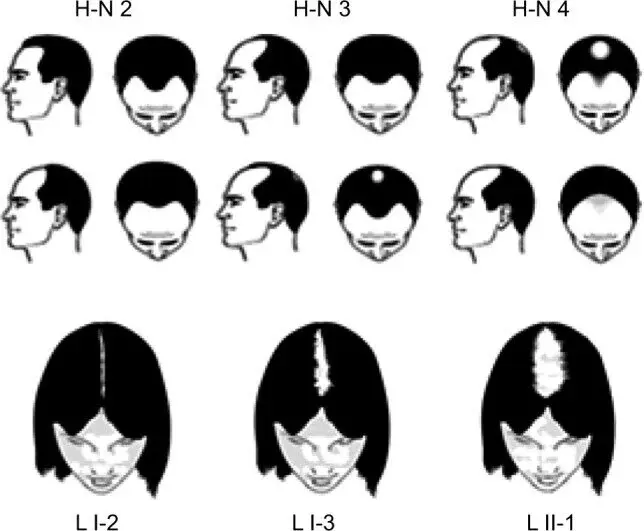
Recognition patterns of androgenetic alopecia differ clearly between men and women. Characteristic course patterns often make this form of hair loss identifiable at a glance.
Typical patterns in men (Hamilton-Norwood scale)
Hair loss in men follows the Hamilton-Norwood scale, divided into seven stages [9]. The scale begins with mild temple recession (stage II) and ends with advanced baldness, leaving only a narrow fringe of hair (stage VII) [10]. First the hairline recedes at the forehead and temples; later a bald spot forms on the crown [9]. In about 80% of affected men, hair loss follows this pattern [11]. In advanced stages, the bald areas at the front and crown merge [10].
Typical patterns in women (Ludwig scale)
In women, androgenetic alopecia instead begins in the mid-part area [12]. The Ludwig scale describes three stages: in stage I the hair thins slightly at the part, while stage II shows clear thinning [13]. In stage III the scalp becomes fully visible, though the frontal hairline usually stays intact [14]. Women rarely develop a complete bald area — instead, an even thinning of the scalp hair develops [4].
When does hair loss begin?
Androgenetic alopecia can start any time after puberty [5]. In men it typically begins between ages 30 and 40 [4], but can appear in adolescence [15]. In women, hair loss usually manifests between ages 20 and 40 and often worsens after menopause [15].
How quickly does it progress?
The course is individual and not predictable [5]. Early onset, however, often points to a more severe course [5]. In women it is a gradual process [15]. The earlier hair loss is recognized, the better the treatment outlook, though results usually only become visible after three months [4].
Treatment options and their effectiveness
Several effective treatment options are available today for people with androgenetic alopecia. Choice of therapy depends on factors such as sex, age, and how far hair loss has progressed.
Minoxidil: use and effect
Minoxidil widens the blood vessels of the scalp and thereby improves nutrient supply to the hair follicles [3]. Originally developed as a blood pressure medication, it is now used as a 5% solution or foam for men and as a 2% solution for women [3]. In 80–90% of users hair loss can be stopped; in about 50% the hair visibly densifies [16]. However, minoxidil only works while it is used — after stopping, hair loss returns [3]. Side effects can include scalp redness, flaking, and in women unwanted facial hair growth [3].
Finasteride: benefits and risks
Finasteride inhibits the enzyme 5-alpha-reductase and thereby prevents conversion of testosterone to DHT [17]. At a daily dose of 1 mg it can stop hair loss in 80–90% of male patients and visibly densify hair in about 50% [16]. Finasteride is approved only for men and can cause side effects such as reduced libido, erectile dysfunction (in about 2% of users), and depression [17]. In rare cases these symptoms persist after discontinuation (post-finasteride syndrome) [18].
Hair transplant: process and outlook
In a hair transplant, hair follicles are taken from the nape area and placed into bald spots [19]. This method offers lasting results, though advanced hair loss may require several procedures [19]. Not every patient is a candidate — important factors include sufficient donor area, healthy scalp, and realistic expectations [20].
Alternative methods: PRP, laser, supplements
Treatment with platelet-rich plasma (PRP) uses the body's own growth factors to stimulate hair growth [2]. Studies show moderate success [21]. Low-level laser therapy (LLLT) stimulates mitochondria in the hair follicles and can be effective in mild to moderate alopecia [22]. Among supplements, zinc, iron, and L-cysteine have shown some benefit, but only when a deficiency is confirmed [23].
What really does not help: shampoos, cures, home remedies
Special shampoos, home remedies, and cosmetic products can improve appearance in the short term, but they do not affect the underlying mechanism of androgenetic alopecia [4]. Despite big promises, most over-the-counter hair growth products lack sufficient scientific evidence [24].
Exosome therapy with microneedling: when it makes sense
Exosome therapy combined with microneedling is especially suitable for patients with early or moderate hair loss. It aims to support follicle regeneration and stimulate hair growth at the cellular level. Cost per session usually ranges between €500 and €1,500 depending on product and provider. As a non-surgical, minimally invasive treatment, it is generally well tolerated and carries only low risks. The therapy works best when follicles are still active; in advanced or scarring alopecia its effect is limited. Realistic expectations are essential for satisfaction with the outcome.
Conclusion
Androgenetic alopecia is not a disease in the strict sense, but a genetically determined hypersensitivity of the hair follicles to DHT. It is a widespread phenomenon that affects both men and women, though with different patterns and frequencies.
While many people look for quick fixes, the scientific evidence clearly shows that only a few treatment methods are truly effective. Minoxidil and finasteride can, with consistent use, stop hair loss in up to 90% of those affected and even promote new growth. These medications must be used continuously, however, because hair loss returns after stopping.
In advanced hair loss, a hair transplant offers a lasting solution. Alternative methods such as PRP and laser therapy are among the promising approaches, yet long-term studies that clearly prove their effectiveness are still lacking.
The earlier androgenetic alopecia is recognized and treated, the better the outlook. At the first signs of hair loss, a visit to a dermatologist is therefore recommended. They can not only diagnose the exact cause but also create an individual treatment plan.
In summary: although androgenetic alopecia is not curable, effective treatment options are available today. The choice of therapy should always consider personal circumstances, sex, and possible side effects. Despite genetic predisposition, no one has to simply accept their fate — with the right measures, hair loss can be countered effectively.
References
[1] - https://www.haar-ausfall.com/erblich-bedingter-haarausfall/ursachen/
[2] - https://www.usz.ch/fachbereich/dermatologie/angebot/prp-behandlung-eigenbluttherapie-haarausfall/
[3] - https://www.regaine.de/haarausfall/minoxidil-bei-haarausfall-info
[4] - https://www.endokrinologen.de/androgenetische-alopezie.php
[5] - https://www.usz.ch/krankheit/hormonell-bedingter-haarausfall/
[6] - https://deximed.de/zielseiten/krankheiten/androgenetische-alopezie/
[7] - https://www.ifue-haartransplantation.de/haarausfall/erblich-bedingter-haarausfall/
[8] - https://www.qualiderm.ch/androgenetische-alopezie/
[9] - https://de.wikipedia.org/wiki/Hamilton-Norwood-Schema
[10] - https://www.beautymax.de/lexikon-schoenheit/hamilton-norwood-schema-haarausfall/
[11] - https://clinic-pilopro.ch/hamilton-norwood-schema/
[12] - https://www.mybody.de/haarausfall-frauen-schema-nach-ludwig.html
[13] - https://cosmedica.com/de/ludwig-skala-klassifizierung-der-weiblichen-glatzenbildung/
[14] - https://www.onmeda.de/krankheiten/haarausfall/androgenetische-alopezie-id201490/
[15] - https://www.ducray.com/de-de/haarausfall-was-tun-wenn-das-haar-buschelweise-ausfallt/androgenetische-alopezie-ursachen-symptome-therapien
[16] - https://www.aerzteblatt.de/archiv/diagnostik-und-therapie-von-haar-und-kopfhauterkrankungen-e704695d-17d2-4b9b-a781-a7d9ff89fd8b
[17] - https://flexikon.doccheck.com/de/Finasterid
[18] - https://www.zavamed.com/de/finasterid.html?srsltid=AfmBOorbMDg-03hq_MhNaV0KNFZVGAyRh8i49HqOsHy10USywfW8qBjX
[19] - https://elithairtransplant.com/german/androgenetische-alopezie-ursache-haarausfall/
[20] - https://volomedestetik.com/de/ist-jeder-patient-mit-haarverlust-ein-kandidat-fur-eine-haartransplantation/
[21] - https://www.universimed.com/ch/article/dermatologie/plaettchenreiches-plasma-prp-bei-androgenetischer-alopezie-aga-2096455
[22] - https://derma-neuerwall.de/dermatologie/haarausfall-haarerkrankungen/laser-gegen-haarausfall/
[23] - https://www.doccheck.com/de/detail/articles/41974-haarausfall-da-hilft-doch-zink-oder
[24] - https://www.lexikon.haar-zentrum.com/haarlexikon/therapien-minoxidil-finasterid-microneedling/wenig-wirksame-therapien/