Hair transplant
Hair Implantation: What Experts Don't Tell You
What do experts leave out about hair implantation? Hidden risks, realistic success rates, and practical tips before you decide.
Hair implantation in Switzerland costs between CHF 5,000 and 15,000, depending on the scope of the procedure. Many people consider this step but do not know what they should really look out for.
When we talk about implanting hair or hair transplantation, there are many aspects that often go unmentioned in standard consultations. For example, graft survival rates of 80–95% are encouragingly high, but pain perception during the procedure varies strongly from person to person. Successful transplant results can also last for several decades, which surprises many patients.
In this comprehensive guide we cover everything you need to know — especially the points experts may not emphasise. We explain not only the differences between procedures, but also why costs in Turkey, averaging about EUR 2,200 to 3,700, are often clearly lower than in Germany.
What is hair implantation really?

There is often confusion around the term hair implantation. While many people use the terms interchangeably, there are important technical distinctions worth understanding.
Definition and how it differs from hair transplantation
Hair transplantation is a surgical procedure in which hair follicles are taken from one area of the body (usually the back of the head) and moved to bald or thinning areas. It is a transplant of your own body hair. The term “hair implantation” is often used misleadingly, because it can suggest that artificial hair might be inserted.
In modern treatment, only the patient’s own hair follicles are used. Artificial hair fibres were used in the past, but they were banned in many countries because of complications. Today, “implantation” usually refers only to the technique of placing natural follicles.
Why the term is often misunderstood
“Hair transplantation” and “hair implantation” are frequently mixed, which leads to false expectations. One main reason is inconsistent use of the specialist terms. While “transplantation” covers the whole process, “implantation” strictly speaking refers only to placing the follicles.
This terminology confusion leads many people to believe wrongly that artificial hair is used in hair implantation. Those misunderstandings also deter potential patients from contacting a specialist.
Which techniques are used today
Several techniques currently dominate the market:
FUT (Follicular Unit Transplantation): A strip of hair-bearing skin is taken from the donor fringe and divided into smaller units that are then placed into prepared sites. This method leaves a visible scar.
FUE (Follicular Unit Extraction): In this more modern method, individual hair follicles are harvested directly from the scalp and transplanted. It is considered gentler and leaves no linear scar.
DHI (Direct Hair Implantation): This is not a separate transplant method but a specialised implantation technique. With an implanter pen, hair follicles are placed directly after harvesting via FUE.
Sapphire FUE: A further development of FUE using special sapphire blades that allow particularly precise cuts.
The FUE method in particular has gained popularity in recent years since Dr. William Rassman and Dr. Robert Bernstein presented it in an article in 2002.
Who is really suitable for hair implantation?
Not everyone is a good candidate for hair implantation — a fact many clinics often leave out. The medical prerequisites are complex and vary individually.
Requirements for successful treatment
The best candidates for a hair transplant are people with genetic hair loss (androgenetic alopecia). For optimal results, hair loss should have been stable for at least two years. Good general health is also essential, because hair implantation is a surgical procedure. People with serious chronic conditions such as uncontrolled diabetes or heart disease should refrain from treatment.
Why not every patient is suitable
Various factors can speak against hair implantation. These include autoimmune diseases such as lupus or alopecia areata, serious clotting disorders, and psychological issues such as body dysmorphic disorder. Smokers also have poorer healing prospects, because microcirculation is impaired.
The underestimated importance of donor hair density
The quality and density of donor hair are decisive for success. An adequate hair fringe at the back of the head is essential, because that is where follicles are harvested. Patients should know that even after several treatments, only about 40–80% of the original density in the treated area can typically be achieved relative to native density. With advanced hair loss, the donor area is often insufficient.
Common misjudgements in young patients
Hair transplantation is especially problematic in patients under 25. Hair loss at that age is often not yet complete, which can lead to an unnatural appearance later. Many young men underestimate that their hair loss will continue — including after a transplant. A family history can help estimate the future course of hair loss. That is why many reputable physicians first recommend conservative treatment with finasteride.
Process, risks, and what nobody tells you
"Hair transplant results differ from patient to patient — and that is only natural." — HairPalace expert team, hair transplant specialists, HairPalace Clinic
The surgical process of hair implantation remains a mystery for many, even though it is a relatively straightforward procedure. The details often skipped in consultations deserve particular attention.
Preparation: what physicians rarely emphasise
Before every hair transplant, a blood test is performed. It is also important that you stop blood-thinning medication at least ten days before the procedure. Alcohol and nicotine should likewise be avoided at least on the evening before treatment. These precautions are decisive for success, but in consultations they are often mentioned only in passing.
The procedure: what really happens
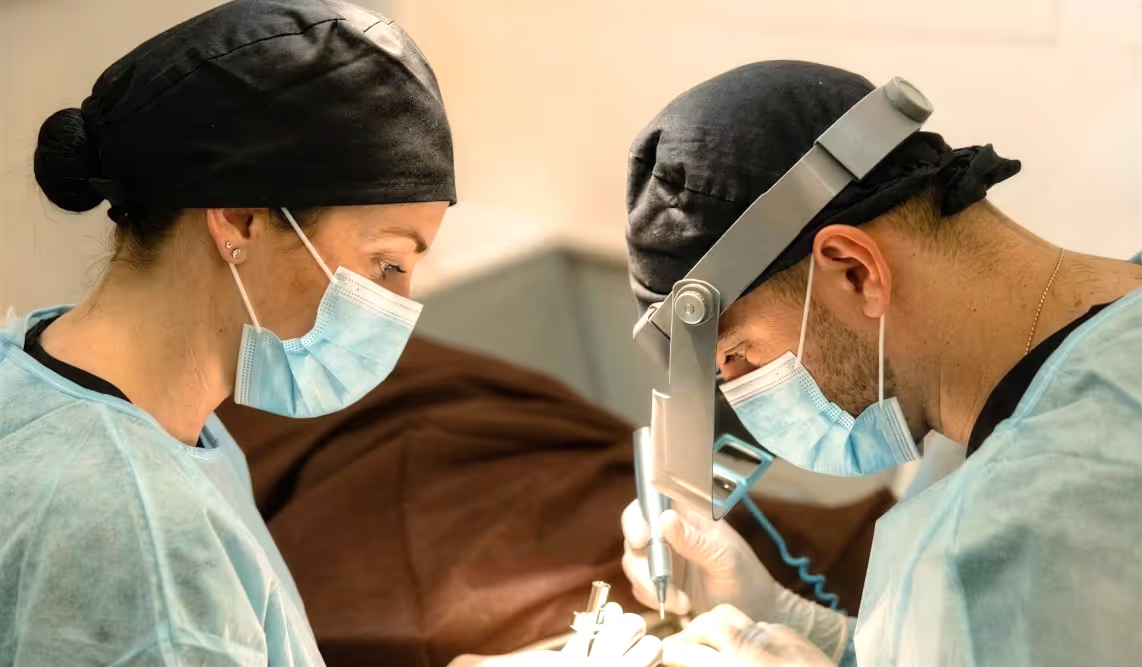
A hair transplant lasts between 4 and 8 hours depending on scope. After local anaesthesia, follicles are harvested and stored in a nutrient solution at 4°C. When placing the grafts, growth direction is decisive for a natural look. The procedure itself is pain-free, though excessive anaesthetic can lead to swelling.
Aftercare: the critical phase
The first 72 hours after hair implantation are the most critical for graft survival. Facial swelling affects about 42.5% of all patients and can last up to two weeks. In the first days, scabs form to protect against infection. For optimal results, avoid any mechanical irritation of the scalp for the first two weeks.
Hidden risks and rare complications
While hair transplantation is considered safe, risks still exist: folliculitis occurs in about 12.1% of patients. Infection risk is under 1%. An extremely rare but dangerous complication is scalp necrosis, at only about 0.1%. Temporary numbness can also occur.
Why results often only show after 12 months
So-called shock loss affects about 45% of all patients — the transplanted hairs shed within the first three months while the roots enter a resting phase. New hair typically begins to grow only about three months after the transplant. Full results are usually visible between 12 and 18 months, because the hair needs time to grow and stabilise.
Costs, alternatives, and hidden expenses
Financial aspects of hair implantation often play a decisive role. Behind the obvious costs are details patients should know.
What does hair implantation really cost?
In Switzerland, hair transplant costs range between CHF 5,000 and CHF 15,000. Prices vary with the size of the bald area, the number of grafts needed, and the method chosen. A single graft costs on average between CHF 4 and 7. With more extensive procedures involving hair robots, costs can rise to around CHF 15,000.
Why Turkey is cheaper — and what to watch for
A hair transplant in Turkey costs between EUR 1,500 and 3,500, often including accommodation and transfers. This large price gap results from roughly 200% lower living costs. However, cheap offers carry risks: some clinics perform 40–50 procedures a day, with surgery carried out by non-medical staff.
Hidden extra costs in Germany
Besides the obvious costs, additional expenses often arise in Germany: consultations, aftercare, special hair washes, and medication. Health insurers generally do not cover aesthetic procedures — exceptions exist only for medical necessity.
Alternatives: PRP, minoxidil, pigmentation
PRP therapy (autologous blood treatment) costs between CHF 450 and CHF 750 per session. This method stimulates hair growth by injecting platelet-rich plasma into the scalp. A cheaper alternative is micropigmentation (CHF 300–5,000), in which bald areas are tattooed to create the illusion of shaved hair.
When medication makes more sense than surgery
Finasteride and minoxidil can stop hair loss and are effective in early stages. However, hair falls out again after stopping the medication. Significant side effects such as loss of libido can also occur. This option is especially suitable for patients with mild hair loss or as complementary treatment.

Choosing a hair transplant requires careful consideration and comprehensive information. The procedure can offer promising results for suitable candidates, but you should be aware of the aspects covered in this article.
First, suitability must be assessed realistically. Not every patient is an ideal candidate — especially people with certain underlying conditions or younger people whose hair loss has not yet stabilised. Donor hair density also plays a decisive role in success.
The price difference between Germany and Turkey is explained by lower living costs, but treatment abroad also carries risks you must weigh carefully. Quality has a price — especially for medical procedures.
Waiting for the final result requires patience, because full results only become visible after 12–18 months. During that time, transplanted hairs pass through several phases, including initial shock loss.
Alternatives such as medication or PRP can be sensible options for some patients, especially with milder hair loss or as a complement to transplantation.
Ultimately, choosing the right specialist remains the most important factor for a satisfying result. Look for demonstrable experience and documented outcomes in previous patients. Investing in a high-quality hair transplant can be costly, but it pays off through long-term natural-looking results and greater self-confidence.