Hair transplant
Hair Transplant 2025: What Doctors Don't Say Directly
What consultations often leave out about hair transplants in 2025 — chances, risks, and newer techniques in a clear overview.
About 85 percent of hair transplant procedures today are performed on men, even though two in five women also experience increased hair loss over their lifetime. For specialists it is a relatively straightforward, low-risk procedure — yet for patients it raises many questions.
While hair transplant costs in Germany and Switzerland typically lie between CHF 4,000 and CHF 9,000, prices vary considerably with scope and technique. For an area of only 50 square centimetres, 500 to 1,000 hairs are already needed. This article covers what consultations often do not state directly — from hidden cost factors to realistic success rates with graft survival of 80–95%.
What doctors don't say: the real reasons for hair loss

Genetic causes and hormonal influences
Androgenetic alopecia is about 95% the most common form of hair loss in both sexes. The name already points to the main cause: a genetically determined hypersensitivity of hair follicles to male sex hormones (androgens).
In that hypersensitivity, the hormone dihydrotestosterone (DHT) plays the main role. It is formed from testosterone by the enzyme 5-alpha-reductase. DHT shrinks hair follicles, shortening the growth phase. Hair no longer grows as long, becomes thinner, and sheds faster.
In men, change typically begins between ages 30 and 40, but can start earlier. Early onset often indicates a more severe course. In women, hereditary hair loss often appears only from age 40, though in rare cases it can begin at 20.
Hormonal fluctuations can worsen hair loss further. In women, menopause, pregnancy, or stopping the contraceptive pill can trigger hair problems. After pregnancy, many women experience increased shedding from about week 8 after delivery, lasting up to six months.
Stress, nutrition, and lifestyle
What many physicians do not address directly: chronic stress plays a decisive role in hair loss. Under stress the body releases more cortisol, which inhibits hair growth. The number of nerve fibres around hair follicles also increases, releasing pro-inflammatory messengers. These irritate immune cells and cause neurogenic inflammation.
Physicians report that stress-related hair loss is increasing. The good news: after the stress phase ends, hair usually grows back — often even stronger than before.
Nutrition is equally important. Healthy hair growth needs enough of:
- Iron: In women especially, iron deficiency leads to diffuse hair loss. Hair growth typically normalises only when serum ferritin is above 70 ng/ml.
- Zinc: Deficiency weakens hair structure and leads to thinning hair.
- Biotin (vitamin H): Deficiency is linked to hair loss. Studies show that biotin therapy clearly improved diffuse hair loss in 64 percent of patients.
- Vitamin D: Especially in autumn and winter, vitamin D deficiency can worsen hair loss.
Alcohol and nicotine worsen the situation further, because they dehydrate the body and constrict blood vessels, reducing oxygen supply to the hair roots.
Medications and environmental factors
Hair loss has been listed as a side effect for over 400 medications. The following drugs particularly often cause hair loss:
Beta-blockers for high blood pressure can lead to dying hair roots. Blood thinners such as heparin also damage hair follicles. Even common painkillers such as ibuprofen can cause hair loss with frequent use. Antidepressants with active ingredients such as imipramine or fluoxetine shorten hair lifespan, and the side effect can persist for up to a year after stopping.
Contrary to common assumptions, there is no evidence that chemical environmental pollution leads to increased hair loss. Isolated hair analyses for environmental toxins are therefore usually unjustified and of little use.
Before an expensive hair transplant in Switzerland or Zurich, discuss these factors with your physician. Sometimes adjusting medication, reducing stress, or correcting nutrient deficiencies can stop hair loss — and save considerable transplant costs.
Am I really suitable for a hair transplant?
Not every hair loss can be fixed with a transplant — a realisation many patients only reach after several consultations. Suitability depends on numerous factors that should be checked carefully before deciding.
When a transplant makes no sense
The most promising candidates for a successful hair transplant are people with genetic hair loss. For other forms, the cause should be clarified first. There are clear contraindications, however:
- Autoimmune diseases: In alopecia areata (patchy hair loss) or scarring forms, a transplant is not suitable. Transplanted hairs would be attacked by the immune system.
- Unstabilised hair loss: With rapidly progressive loss without medical stabilisation, implanted hairs can look unnatural.
- Medical contraindications: Clotting disorders, uncontrolled hypertension, or certain infectious diseases prevent the procedure. A blood test is performed before every hair transplant.
In fact, most physicians advise trying a medical therapy approach first. Only when other treatment methods are exhausted should a transplant be considered.
Why a bald head is not always treatable
In people with complete baldness, transplant technique reaches its limits. Even if a small hair fringe remains at the back of the head, covering the entire bald area is usually not possible.
A decisive limit is available donor hair. While a patient can lose up to 28,000 grafts over a lifetime, only about 6,000 to 7,000 grafts are available in the donor area at best. In patients with advanced hair loss beyond Norwood stage 6, transplants are therefore rarely an option.
Furthermore, the donor area should not be fully harvested during the procedure, so further grafts remain available for possible corrections. In some cases, hair roots from the lower beard area can be taken as a fallback; other body hair is usually not suitable for transplantation.
Hair transplant for women: special challenges
In only about 10% of cases is a hair transplant indicated and helpful for women. Although there is fundamentally no difference in how it is performed compared with men, important specifics apply.
Women often have diffuse hair loss with hormonal causes. Before any hair transplant in women, causes must therefore be clarified especially carefully. This includes:
- Gynaecological evaluation (e.g. around menopause)
- Ruling out deficiencies (iron deficiency, B12 deficiency)
- Checking endocrine disorders (hypothyroidism, PCOS)
Unlike in men, with FUE in women the entire back of the head is never shaved — only fine strips that can later be covered with remaining hair. Still, large transplants of up to 2,000 grafts can be performed in women.
The best success rates for women are with locally limited problems, such as a high forehead or expanding receding temples. With generally thinned hair, success is less predictable.
Although a transplant can be an effective solution, you should always keep realistic expectations before a procedure in Switzerland or Zurich and compare transplant costs with other treatment options.
Techniques compared: what is rarely explained
When choosing a hair transplant technique, physicians often tell only half the story. Differences between procedures are decisive for your result, yet important details are frequently explained only when asked.
FUE vs. FUT: differences, pros and cons
The basic principle of all hair transplant techniques is identical: healthy hair roots are taken from the donor fringe and planted into bald areas. The decisive difference is the harvesting technique.
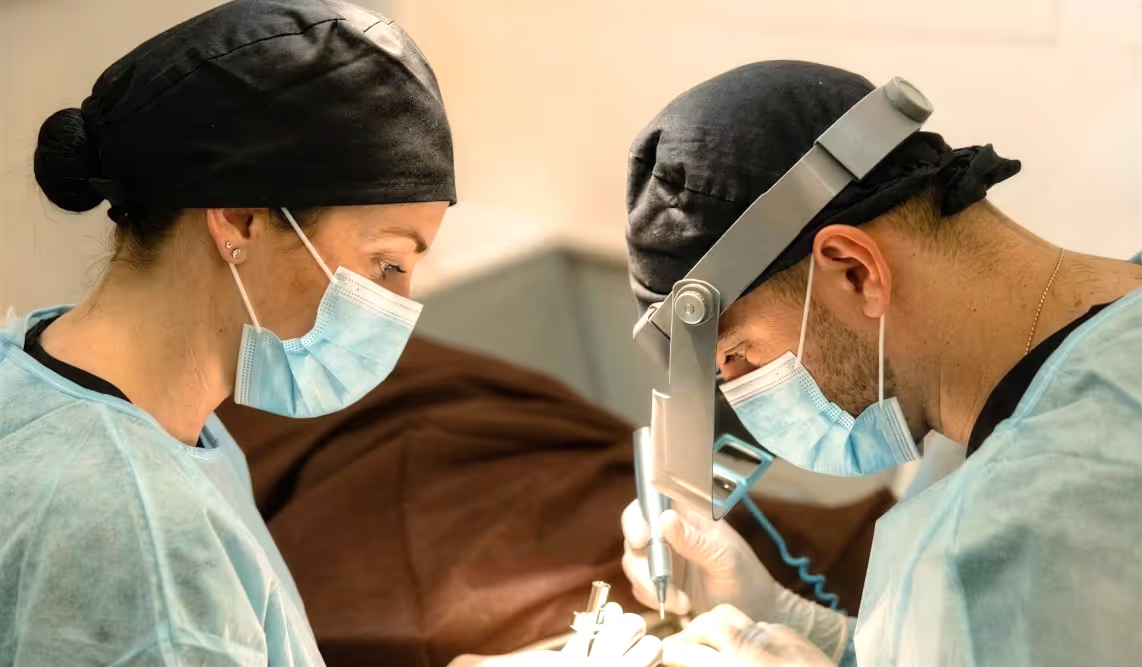
With the FUT method (Follicular Unit Transplantation), a skin strip up to 20 cm long and 1–3 cm wide is removed from the back of the head and sutured. Follicles are then prepared from that strip. With the FUE method (Follicular Unit Extraction), individual hair follicles are harvested directly from the scalp with a fine hollow needle.
Both techniques have specific advantages and disadvantages:
FUT advantages:
- Enables large transplant numbers (up to 3,000 grafts) in one session
- Harvest site immediately combable
- Preserves hair density in the donor area
- More cost-effective for large transplants
FUE advantages:
- No linear scar, only microscopically small pinpoint scars
- Less pain after the procedure
- Sport possible again after about 14 days (with FUT only after 3 weeks)
- Ideal for short hairstyles
While FUT leaves a visible scar that can show with short haircuts, FUE leaves only punctate, barely visible scars. FUE takes longer and is more labour-intensive, however, which makes it more expensive.
Sapphire FUE and i-FUE: marketing or real progress?
Sapphire FUE is a further development of classic FUE. Instead of steel blades, channels for the grafts are opened with sapphire blades. These blades allow finer cuts and cause less trauma to scalp tissue.
i-FUE (Intermittent Follicular Unit Extraction) focuses on how long grafts stay outside the body. While classic FUE grafts can be stored for up to six hours outside the body, i-FUE reduces this time to a maximum of 45 minutes. That leads to higher survival rates and vitality of transplanted hairs.
Although both techniques can offer real advantages, these are often overstated. Especially for sapphire FUE, scientific evidence for the advertised benefits is limited. Experienced hair surgeons can achieve similarly good results with conventional blades.
Direct Hair Implantation (DHI): who is it suitable for?
The DHI method (Direct Hair Implantation) is not an entirely new technique, but a variant of FUE. The main difference: with DHI, harvested follicles are placed directly into the scalp with a special pen (Choi pen), without opening separate channels first.
This method is especially suitable for:
- Setting a new hairline at the forehead
- Transplanting eyebrows or eyelashes
- Patients who want to avoid shaving
- Areas that require particularly precise placement
The greatest advantage of DHI is precision when placing follicles. Control over depth, direction, and angle of each graft is better than with other methods. However, the number of grafts transplantable per day is limited, and the technique requires substantial experience from the treating physician.
Ultimately you should not be dazzled by marketing terms. The best technique depends on your individual needs — so seek advice from a physician who masters all methods and can give you an unbiased recommendation.
Hidden risks and side effects
Behind the supposedly straightforward hair transplant procedure are risks that consultations often mention only in passing. Although complication rates are low, potential patients should know possible side effects.
What can go wrong during healing
Swelling in the forehead and face is a common companion and affects about 42.5% of all patients. It usually resolves within 1–2 weeks, but can reach the eyelids and temporarily restrict the field of vision.
Folliculitis — inflammation of hair follicles — occurs in about 12.1% of patients. It appears as small, painful red papules or pustules that heal within 7–10 days with proper treatment.
There is also a low infection risk of under 1% with every hair transplant. With timely antibiotic treatment, infections usually heal fully within a few days.
An extremely rare but dangerous complication is scalp necrosis, at only about 0.1%. Tissue dies in the donor or recipient area, which can cause permanent hair loss.
Why not all grafts take
Contrary to widespread advertising claims, survival rates even with the most modern procedures are not 100%. With current FUE techniques, more than 90% of transplanted follicles survive on average. The remaining 5–10% are lost during or after transplantation.
A normal phenomenon is so-called shock loss, which affects about 45% of all patients. Freshly transplanted hairs fall out within the first three months while the roots enter a resting phase. Healthy hairs around the transplant site can also shed temporarily.
Further factors that can lead to graft loss include insufficient blood supply, incorrect storage of harvested grafts, or improper care after the procedure.
Long-term scars and sensory changes
Depending on the technique chosen, residual scars differ considerably. FUT leaves a linear scar at the back of the head, while FUE causes only punctate, barely visible scarring.
Many patients report temporary numbness or tingling in the surgical area. These sensory changes disappear on their own within 2–4 weeks for most patients. In fewer than 0.1% of those treated, nerve injuries can occur that in rare cases last up to six months.
Despite modern techniques, scarred tissue heals differently from healthy skin. It is less elastic, thicker, and less well supplied with blood, which can slow healing.
Cost traps and price differences in 2025
Price transparency for hair transplants often leaves something to be desired. While clinics advertise tempting offers, unexpected extras or qualitative differences often hide behind them.
What really drives hair transplant costs?
The main cost driver for hair transplants is clearly labour costs. Beyond that, the number of grafts needed largely determines the price. Depending on the stage of hair loss, different amounts are needed: for mild to moderate loss about 800–2,500 grafts, for advanced loss 2,500–4,000 grafts, and for very severe loss even 4,000–6,000 grafts or more.
The technique chosen also affects price considerably. FUT can harvest more follicles faster, but leaves scars. More modern procedures such as DHI or sapphire FUE require special materials and are therefore more cost-intensive.
Hair transplant Switzerland vs. Turkey: a price comparison
In Switzerland, an FUE hair transplant costs between CHF 4 and 6 per graft. For a treatment with 1,500 grafts, that means between CHF 6,000 and 9,300. By comparison, average costs in Germany are about EUR 2.93 and in Turkey only about EUR 1.07 per graft.
For a comparable treatment in Turkey you pay about EUR 2,675 for 2,500 grafts — a fraction of Swiss prices. In Germany, costs range between EUR 3,500 and 16,000.
The large price difference is explained by several factors: lower labour costs in Turkey, currency differences, and state support for medical tourism. Turkish authorities, for example, reimburse clinics about 70 percent of their advertising spend abroad.
Why cheap offers often become more expensive
It is estimated, however, that 40 to 60 percent of providers in Turkey operate without a licence. In these “hair factories,” trained technicians rather than qualified physicians perform the procedures, which explains the low prices — but also carries risks.
Experts warn: although the new hairline often looks acceptable, too much donor hair is frequently harvested. That leads to thin spots at the back of the head and no material left for follow-up treatments. Failed procedures can necessitate expensive corrective surgery, so overall costs end up higher than with a high-quality first treatment.
Anyone considering a hair transplant should therefore look not only at price, but carefully check physician qualifications, reviews from previous patients, and transparency about the full treatment process.

A hair transplant is undoubtedly an effective solution for many people with hair loss. Before a procedure, however, you should weigh all factors carefully. First, thoroughly clarify the causes of your hair loss — genetic factors, stress, nutritional deficiencies, or medications may be treatable triggers.
Choosing the right technique also plays a decisive role. FUE leaves barely visible scars, while FUT can be more cost-effective for large-area loss. Newer methods such as DHI or sapphire FUE offer advantages, but do not always justify the higher price.
Despite low complication rates, you should know possible side effects. Swelling, temporary shock loss, and rarely occurring infections are risks that must be considered in the decision.
The substantial price differences between Switzerland, Germany, and Turkey explain why many patients consider medical tourism. Still, a low price does not necessarily mean good value. Quality and experience of the treating physician remain the most important factors for a satisfying result.
Ultimately you should have realistic expectations. Not every hair loss can be fixed by a transplant, and even in successful procedures not all grafts take. You make informed decisions best after thorough advice from a qualified specialist who lays out all options transparently — including the information other physicians may not address directly.