Hair transplant
Why More Women Are Choosing Hair Transplants
More women are opting for hair transplants — causes of female hair loss, which methods exist, and what to know before and after the procedure.

Hair transplant for women is increasingly becoming a popular solution for hair loss. About 42% of all European women show signs of pattern hair loss, while the share of women among hair transplant patients was nearly 16% in 2019. For many affected people, this procedure — redistributing hair into bald or thinly covered areas — is a promising option.
The decision for a hair transplant in women is often made after careful consideration. Androgenetic alopecia, which affects up to 42% of all women, is a common reason for this step. This article covers what you need to know about hair transplants for women — from the different methods and costs averaging about EUR 3.29 per graft to convincing before-and-after results. We also explain why about 500 to 1,000 hairs must be transplanted for an area of 50 square centimetres, and what you should consider before and after the procedure.
Causes of hair loss in women

Hormonal changes and genetic factors
The most common form of hair loss in women is androgenetic alopecia, which affects about 25 to 30 percent of all women. In this form, hair roots react hypersensitively to the male hormone dihydrotestosterone (DHT), which forms from testosterone and shrinks hair follicles. This hypersensitivity is inherited; the androgen receptor gene plays a main role.
Unlike men, women are often protected in younger years by high oestrogen levels, because this hormone promotes hair growth. That changes with menopause, when oestrogen falls and androgens become more prominent. Hormone-related hereditary hair loss in women therefore often appears only from age 40.
Hormonal fluctuations during pregnancy, after birth, or when stopping the contraceptive pill can also cause temporary hair loss. After birth, oestrogen falls sharply from about week 8, so more hairs enter the resting phase and shed.
Stress, nutrition, and lifestyle
Prolonged stress can also lead to hair loss. The stress hormone cortisol inhibits hair growth, while the number of nerve fibres around hair follicles increases. These release messengers that trigger inflammatory reactions and lead to cell death. Stress-related hair loss typically appears 2–3 months after the stressful phase.
Nutrition-related factors also play an important role. Iron deficiency is one of the most common causes of hair loss in women. A lack of other nutrients such as zinc, biotin, or vitamin D can also impair hair growth. Crash diets, sudden weight loss, or protein deficiency signal alarm to the body and can accelerate hair loss.
Lifestyle factors such as smoking and alcohol reduce scalp circulation and thereby impair hair growth.
Specifics of female alopecia
The appearance of female hair loss differs clearly from the male pattern. In women, thinning typically begins in the parting area and continues on the top of the head, while the hairline usually stays intact. Specialists call this female-pattern hair loss according to the Ludwig scale.
Unlike men, women rarely develop complete baldness. Instead, hair becomes thinner overall, weaker, and loses volume. This gradual development means many affected people recognise the problem late — often only when the scalp is already visibly shining through.
For women, hair loss is often a stronger emotional burden than for men, because thinning hair is less socially accepted. Exactly here a hair transplant can offer a lasting solution for women, especially when follicles are already permanently damaged.
Which hair transplant methods exist?
"The FUT method has the advantage that the harvest area (usually the back of the head) does not need to be shaved. Thus a hair transplant in women with the FUT procedure can be well concealed." — Haartransplantation-Vergleich.de editorial team, specialist portal for hair transplants
When deciding on a hair transplant, women today have several modern procedures to choose from, each with specific advantages. The optimal method depends largely on the individual hair situation.
FUE: the modern method for fine procedures
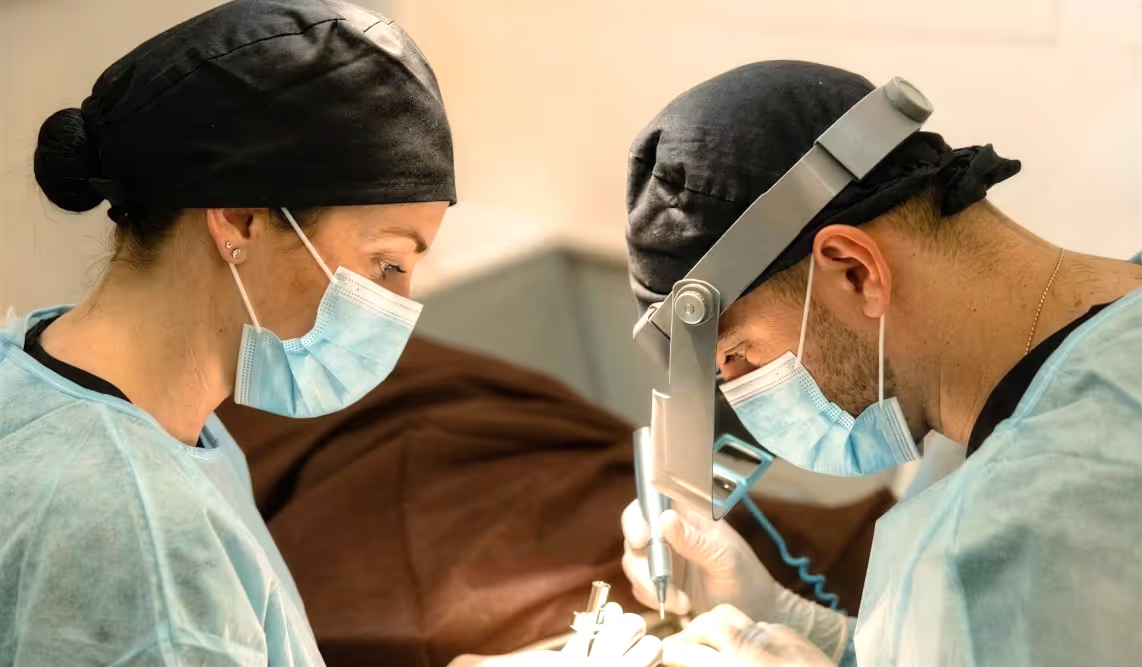
Follicular Unit Extraction (FUE) is considered a minimally invasive, low-complication procedure in which hair follicles are harvested individually with fine hollow needles. This method leaves no visible scars — a decisive advantage for women. Because no coarse instruments such as scalpels are used, strong pain also does not occur. Each follicle is harvested individually and transplanted into a prepared channel, leading to an optically natural, harmonious hair picture. Both harvest sites and the transplant area heal within a few days.
FUT: advantages for women with long hair
Follicular Unit Transplantation (FUT) or the strip method offers an important advantage for women: the back of the head does not need to be shaved. In this technique a skin strip is removed from the back of the head, from which the hairs to be transplanted are separated individually for implantation. The resulting scar can be concealed under the hair above it. For women who do not want to shave the whole back of the head — whether because of hairstyle or after chemotherapy — FUT is an excellent alternative.
DHI: for precise results in small areas
Direct Hair Implantation (DHI) is a further development of the FUE technique. In this method, hair follicles are implanted directly with the innovative Choi pen without first creating channels. This enables extremely precise control of placement angle and growth direction. Especially advantageous for women: DHI can be performed without shaving. The exact angle of transplanted hairs (40–45 degrees) ensures a natural result. With a graft survival rate of over 90%, DHI shows excellent results.
Eyebrow and hairline corrections
Specialised techniques also enable correction of eyebrows and hairlines — an area especially relevant for women. An eyebrow transplant typically needs 150–200 single-hair implantations and lasts about 2–3 hours. Angles and growth directions play a decisive role here for a natural result. For hairline correction, FUE is often used, especially when receding temples are corrected or eyebrows filled at the same time. The hairline is then optimally positioned according to the “golden ratio” principle.
Why are more women choosing a hair transplant?
"According to statistics, the number of hair transplants in women has risen by more than 20% in the last ten years." — International Society of Hair Restoration Surgery (ISHRS), leading global professional society for hair restoration
The number of women choosing a hair transplant is rising continuously. The share of female patients increased by 2 percent within only two years. This development has several reasons that go far beyond purely aesthetic aspects.
Growing awareness of aesthetic solutions
Especially for women, hair is an important beauty feature and stands strongly for female attractiveness and elegance. Up to 20 percent of all women suffer from hereditary hair loss, often linked to a substantial loss of self-worth. In today’s society there is growing awareness that modern medical solutions are available that can help effectively and lastingly.
Lasting results through resistant hair roots
A decisive advantage of hair transplantation is the durability of results. Hair follicles taken from the back of the head are genetically resistant to DHT — the hormone mainly responsible for hereditary hair loss. These DHT-resistant follicles keep their original properties after transplant and grow permanently. Over 90 percent of hair transplants last longer than 10 years, and many treatments even last a lifetime.
Discretion through modern techniques
Modern methods such as long-hair FUE and DHI offer a decisive advantage: they can be performed without visible shaving. Especially in hair transplants for women, not whole areas but only fine strips at the back of the head are shaved. This enables maximum discretion during healing. Harvest sites and transplant areas also heal within a few days.
Before-and-after results convince
Finally, the impressive results speak for themselves. Before-and-after images give a realistic insight into achievable quality. After 9 to 12 months, patients can already enjoy their new appearance. Numerous positive experience reports confirm high satisfaction: patients report regained self-worth and improved quality of life. With fuller hair, women can feel more feminine and attractive again — an aspect that for many is the decisive reason for this step.
What women should consider before and after the procedure
A successful hair transplant in women requires careful preparation and aftercare. Success depends largely on proper preparation and consistent care after surgery.
Preparing for the hair transplant
First, avoid alcohol for at least two days before the procedure and do not take blood-thinning medication such as aspirin. Avoid hairspray, gel, or hair lotion on the day of surgery. Wash your hair thoroughly on the morning before the procedure. If you have chronic illnesses, discuss this with your physician beforehand. Sufficient sleep (at least eight hours) the day before supports healing.
Healing course and scalp care
In the first days after a hair transplant, pain, redness, and swelling can occur. Transplanted follicles enter a resting phase. From the third day you may carefully wash your hair with lukewarm water. Use the special care products provided after the procedure. A moisture spray keeps the scalp elastic and prevents scabs from cracking.
Sport, sleep, and avoiding sun
In the first two weeks you should avoid sport and sweat-inducing activities. After three weeks you can resume normal sport; weight training at the earliest after four weeks. When sleeping, an elevated head position is important to minimise swelling. Use a neck pillow to avoid direct pressure on the back of the head. Sun exposure should be avoided for at least two weeks, preferably three months.
When do the new hairs grow?
Transplanted hairs fall out after 2–4 weeks (shedding phase). This is normal and no cause for concern. About 4–6 months after the transplant new hairs begin to grow. After six months, hairs become denser and more clearly visible. The final result is reached after 12–18 months.
Cost overview and financing options
Flexible options exist for financing a hair transplant. Many clinics offer instalment plans with 0% interest for terms of up to 12 months. Longer terms of up to 72 months are possible with an effective interest rate of about 7.9%. For financing approval you typically need: majority age, main residence and bank account in Germany, regular net income of at least EUR 350 per month, and no negative credit record.

Hair loss is a substantial emotional burden for many women. Still, modern hair transplant techniques can offer a lasting, aesthetically convincing solution. The growing number of female patients confirms this impressively. Especially the option to have the procedure performed discreetly, and the high success rate with DHT-resistant follicles, make treatment attractive for many women.
The different methods — FUE, FUT, and DHI — each offer individual advantages. While FUT does not require shaving the back of the head, DHI enables precise results in small areas. The right choice depends on your personal hair situation and preferences.
The decision for a hair transplant should still be well considered. Careful preparation and consistent aftercare are decisive for success. Patience pays off, however, because the final result after 12–18 months is usually impressive and lasts for many years.
In summary, hair transplants in women not only bring an aesthetic improvement, but often also clearly raise self-worth and quality of life. Flexible financing options also make the procedure affordable for many women. Anyone suffering from hair loss should therefore consider a professional consultation — the first step to new confidence and a positive feeling with fuller hair.